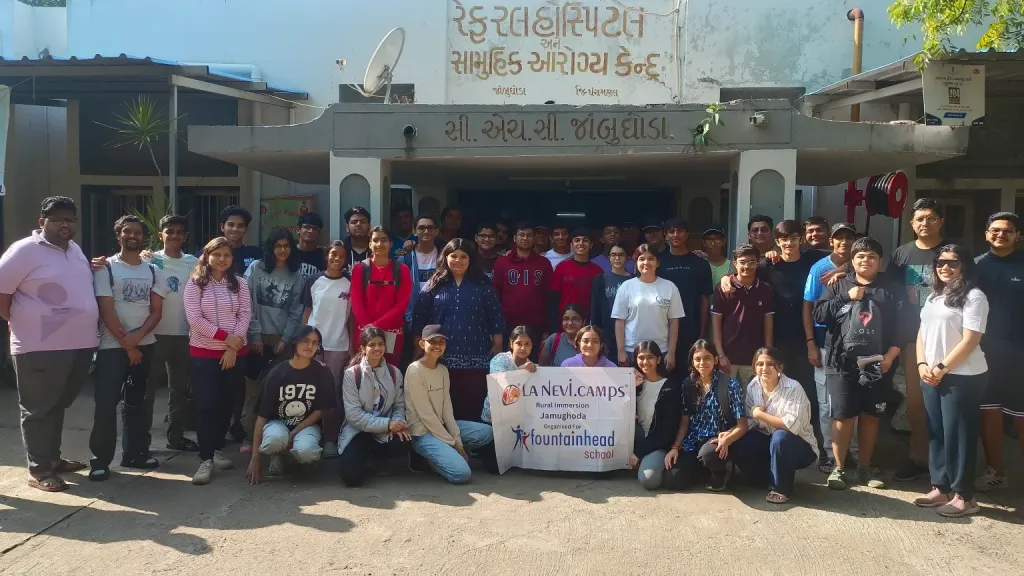
As part of my CAS (Creativity, Activity, Service) experiences, I had the incredible opportunity to go on a rural immersion trip to Jambughoda, Dang, Gujarat. This six-day trip was full of enriching experiences where I interacted with the local villagers, learned new skills, and reflected deeply on various aspects of life, culture, and self-development. From trekking through the mountains to painting a government school, from cooking dinner to pottery-making, each activity was a journey of personal growth and learning. Here’s a deeper look at how this trip allowed me to meet several CAS Learning Outcomes (LOs), with a special focus on the ones I had yet to cover.
LO 1: Identify Own Strengths and Develop Areas for Growth
Before the trip, I knew I was socially awkward, and staying with my classmates for six days seemed like an intimidating challenge. At first, I felt like an outsider, struggling to connect with others. However, over time, I recognized my own growth. I started initiating conversations, sharing meals, and enjoying the company of people I had barely spoken to before. This experience helped me realize that socializing is a skill that can be developed, and I learned to break out of my comfort zone. As I exchanged tiffins and joined in games and activities, I grew more confident in forming new connections, leaving behind the discomfort that once held me back.
On the physical front, one of my strengths was trekking. Thanks to my skating training, I was well-prepared for the physical challenges of hiking through rough terrains. Trekking wasn’t just physically demanding but also mentally uplifting. I enjoyed the beauty of nature and the sense of accomplishment when we reached our destination.
Moreover, visiting the government school in the village made me reflect on how fortunate I am to have access to excellent educational resources. Witnessing the children’s enthusiasm for learning despite minimal infrastructure made me appreciate what I have and motivated me to be more grateful for the privileges I often take for granted.
LO 2: Demonstrate That Challenges Have Been Undertaken, Developing New Skills in the Process
This trip pushed me to develop skills that I had never imagined trying. One such skill was bamboo basket-making. Initially, I struggled with the process and didn’t understand how to weave the bamboo properly. But with guidance from the local villagers, I slowly picked up the technique. It was a rewarding experience to create something with my own hands, and it taught me the importance of persistence.
Cooking was another challenge I faced. Until then, my cooking repertoire was limited to making basic dishes like Maggi. During the trip, we were tasked with preparing our own dinner, and I had the opportunity to cook dal for the first time. It was a simple dish, but cooking it gave me a sense of independence and accomplishment. I also learned about other local dishes prepared by my friends, enriching my knowledge of different cuisines and cooking techniques.
Pottery-making was another first for me. I had never worked with clay before, and it was both a physical and creative challenge. Through trial and error, I learned the art of shaping clay and turning it into a useful or decorative item. This process taught me patience, focus, and the importance of learning from mistakes.
LO 5: Demonstrate the Skills and Recognize the Benefits of Working Collaboratively
Collaboration was essential during this trip, and I learned that working together not only makes tasks easier but also more enjoyable. During our cooking session, we worked in teams to prepare different dishes. I was part of a group that worked on preparing okra curry and dal. While some teammates got instructions from the cook, others chopped vegetables, and we all contributed to making sure everything was cooked perfectly. This teamwork helped us complete the task efficiently and made me realize the importance of delegating tasks based on individual strengths.
Another example of collaboration was when we painted the wall of a local government school. A group of five students with artistic skills worked together to create a mural. Each of us brought different ideas to the table, and we blended them into a unified design that reflected the culture of the village. The project was completed quickly because of our collective effort, and it was incredibly satisfying to see our artwork come to life on the school’s wall.
LO 4: Show Commitment to and Perseverance in CAS Experiences
The rural immersion trip tested my perseverance, especially during physically demanding activities like trekking and painting. The trek required stamina, and I had to push myself to keep going despite the heat and exhaustion. Similarly, painting the school wall was a long and tedious task, but we all stayed committed, knowing that the result would be worth it. Despite facing obstacles, we never gave up, and this commitment to the process was an integral part of my personal growth during the trip.
LO 6: Demonstrate Engagement with Issues of Global Significance
One of the most eye-opening experiences of this trip was our visit to the local government hospital. Many media outlets portray government hospitals in India as poorly equipped and unhygienic. However, what we saw was quite different. The hospital was clean, and the staff was dedicated. We learned about the genetic condition Thalassemia, which affected many people in the village. The experience helped me realize the importance of healthcare, especially in rural areas, and I gained a new perspective on how the government is working to improve healthcare services in the country.
We also visited a local school where students, despite lacking infrastructure, took the initiative to clean their classrooms and contribute to the school’s upkeep. This showed me that lack of resources should not be an obstacle to education. Small self-driven efforts can create big impacts. Additionally, visiting the Sakhi Mandli (women’s cooperative) revealed how financial independence is a crucial part of empowering women in rural areas. By coming together to create a financial cooperative, the women were able to secure their livelihoods and bring about gender equality within the community. This experience made me reflect on how I can contribute to issues of gender equality and financial empowerment in my own community.
LO 7: Recognize and consider the ethical implications of choices and actions was central to how I approached my interactions and activities. One significant ethical consideration was cultural sensitivity. I had to respect the villagers’ way of life, traditions, and values, refraining from imposing external judgments or trying to change their lifestyle. This was especially important when engaging with the community in a respectful manner, understanding their minimalist living and how it tied to their values.
Learner Profiles
Throughout this experience, I embodied several of the IB Learner Profiles:
- Communicators: Despite the language barrier, I was able to communicate effectively with the villagers, learning basic Gujarati phrases with the help of my friends. We also exchanged ideas, collaborated on tasks, and created a connection with the people in the village.
- Open-minded: Living with villagers who had a completely different way of life challenged my perspectives. I embraced the cultural differences and learned to appreciate their minimalist approach to life.
- Reflective: This trip prompted me to reflect on my own life. I was able to identify areas of personal growth, particularly in socializing and appreciating the resources I often take for granted.
- Caring: Interacting with the children in the village, playing games with them, and painting their school’s wall were moments that made me feel connected to the community. The children’s joy and gratitude were deeply rewarding and reminded me of the importance of kindness and compassion.
Conclusion
This rural immersion trip to Jambughoda, Dang, Gujarat, was a transformative experience that allowed me to step outside my comfort zone and grow in ways I never expected. It taught me new skills, reinforced the importance of collaboration, and opened my eyes to issues of global significance such as healthcare, education, and gender equality. Through these experiences, I not only met the CAS learning outcomes but also learned valuable life lessons that will stay with me for years to come.