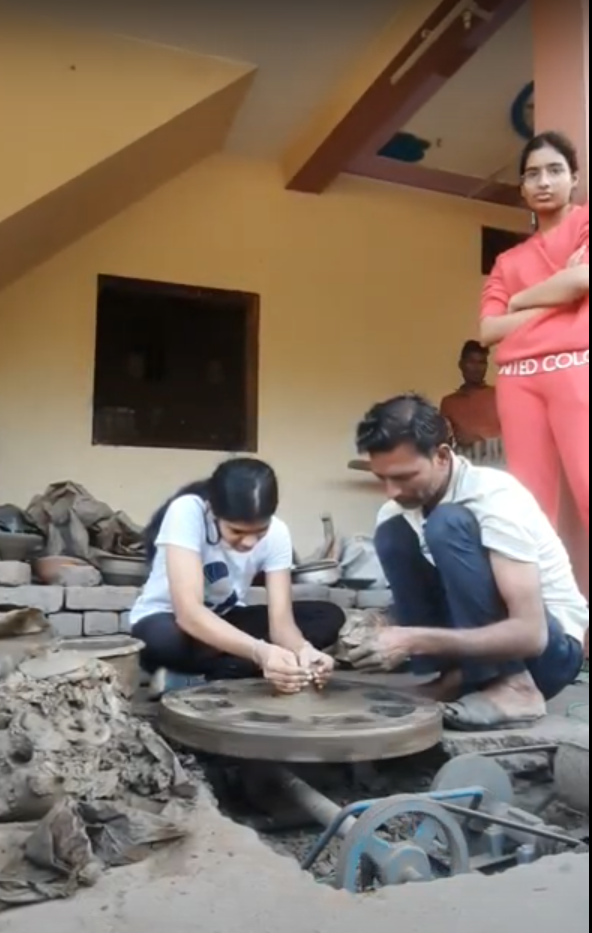
As a part of my CAS experiences, I was taken to Jambughoda, Dang, Gujarat. This was a rural immersion trip where I interacted with the local villagers, visited local school, painted a government school, did trek, created bamboo basket, visited local hospital, interacted with the village’s head, visited local markets and gaushala, visited sakhi mandli, did pottery, cooked dinner and did several adventurous activities.
LOs
LO 1- Identify own strengths and develop areas for growth
During the trip I was able to recognize an area of growth, which was my social skills. I have always been socially awkward, and staying 6 days with classmates was making it even worse. Initially, I was feeling left out and could not enjoy the trip. But slowly and gradually, as we exchanged our tiffin boxes, I started to talk to new people, to whom I never spoke to in years. I started to play with them, talk with them, make new friends, new experiences and refreshing memories for life to cherish. One of my strengths was that I had good trekking skills and fitness, because of skating. So trekking was not difficult for me and I enjoyed it to its fullest. Also that I am not afraid of adventures, I was able to enjoy all the adventurous activities. Also while visiting the government school and village, I realized how fortunate I am to have such a good school with such great facilities. Until now, I had just been complaining about them, but after looking at how the people and children were so happy with such a minimalist life, I started to appreciate everything in my life, making myself happier.
LO 2- Demonstrate that challenges have been undertaken, developing new skills in the process
As I mentioned before, I developed the skill of socializing. Though it sounds insignificant, it is essential to understand evolving human thought processes and developments around the world. Also I developed the skill of making bamboo baskets. It was initially a challenge as I did not understand it properly but as I practiced and took help of the local villager making the basket, I was able to do it. It was something new and satisfying to learn to develop myself. Cooking is an essential skill to ensure livelihood, which everyone should know. We were told to make our own dinner. Until now, I only cooked maggi for myself. During this process, I learnt how to cook dal, and also learnt about other dishes which my friends were making. Also we did pottery there. That was the first time I ever did pottery. I learnt the entire process of pottery making and also learnt a few techniques of pottery.
LO 3- Demonstrate the skills and recognize the benefits of working collaboratively
When we were told to cook, we were divided into groups to prepare a dish. We divided our work, someone was getting instructions from the cook there and was telling us, someone had to chop vegetables etc. I had chopped vegetables for the okra curry and helped to create Dal. Also we were making baskets in a group, which was beneficial as we could identify each other’s mistakes and help each other. Also we, a group of 5 people good in painting, had painted a government school’s wall. All of us had collaborated, as we all had different skills in visual arts which complemented each other. We had put our ideas together and created some designs that could reflect the village’s culture, could be completed in a short period of time, could be done with minimal resources and would embrace the school and its principles. So we came up with warli art, an Indian artform often painted on walls, and helped each other to paint the giant wall.
LO 6- Demonstrate engagement with issues of global significance
We had visited a local government hospital in the village. That actually made us realize the reality. Media has been often portraying government hospitals of India as unhygienic, lacking infrastructure and adequate medical fraternity and equipment. But this was not at all the reality. The government has been upgrading and improving healthcare rapidly. There we understood the genetic healthcare issues, the majority of people in the village had Thalassemia. There we engaged with the healthcare system of the village and understood the progressive steps being taken up to address the issue. Also we had gone to the local school, we interacted with the children. We understood that without a perfect infrastructure, the students had taken initiative for their own learning and used to contribute to the school like cleaning their own school everyday. This made me realize that lack of education, a global issue, can not only be addressed by big authorities, but also small self initiatives. Similarly I learnt how villagers lead a simple and minimalist lifestyle in order to protect their environment. Also during the sakhi-mandli visit, I understood different ways that women can be empowered, to bring gender equality, such as forming such a financial cooperation and making the women financially independent in a village.
Learner profiles
Communicators- As we communicated with the villagers. Though there was a language barrier that I did not speak Gujarati, with my friends’ help, I was able to improve on that.
Open minded- As we interacted and lived around the local villagers, with completely different backgrounds and cultures. But embraced our differences, showcasing open-mindedness.
Reflective-I was reflective as this experience led me to introspect myself. I understood different ways from which any issue could have been addressed, I learnt to appreciate everything I had, my perspective changed and so did my skills.
Caring- I was caring as we had interacting with the children in the village, talking to them, playing games with them, doing garba and playing their school’s wall which brought a huge smile on their faces.
This trip also made me appreciate mother nature. Looking at the villagers initiatives, I also got inspired to work towards preserving the environment, even at the smallest way possible. We understand that Earth does not only belong to humans, but also to the animals and the wildlife, so we can not destroy it. We have to preserve it.