


Mathematics has always been my favorite subject, and my inclination toward it has always been strong. Throughout my education, I’ve consistently excelled in mathematics, and with this commitment, I’ve always achieved high marks. Representing my house, Liberty, in math trivia competitions from grade 7 to grade 10 was something I truly cherished. Each event gave me a chance to engage with the subject I love, making every trivia competition a memorable experience.
So, when the opportunity arose to host the Math Trivia for students of grades 9 and 10, I signed up without hesitation. This time, I was not just a participant; I had the chance to lead the event, ensuring that others would enjoy it as much as I always had. However, organizing an event like this wasn’t as straightforward as coming up with tricky and challenging questions. We spent hours contemplating how the rounds would flow, ensuring they were interactive, engaging, and most importantly, enjoyable for the participants. Our goal was to correct past mistakes from previous hosts, ensuring the trivia felt fun yet challenging, rather than overwhelming or too simplistic.
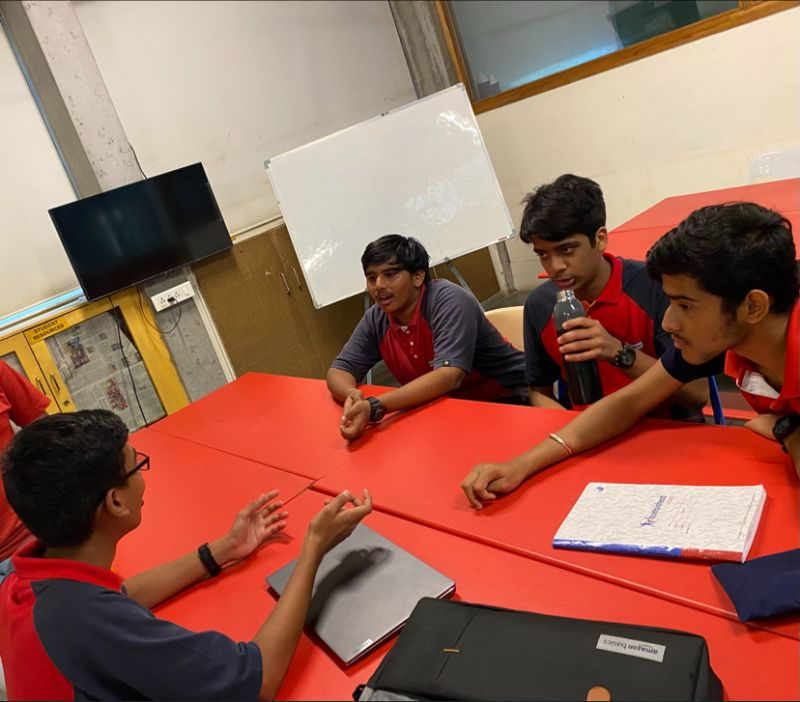
We spent an entire hour discussing about the rounds and how should we take things forward.
Learning Outcome 1 — Identify own strengths and develop areas for growth
My passion for math was both my strength and, in some ways, a challenge during the planning of this event. While I loved the subject and enjoyed creating complex questions, I quickly realized that the level of difficulty needed to be carefully balanced for the juniors. It was easy to get carried away with questions that I found interesting, but which might have been too hard or too obscure for the students participating. When some of my questions were rejected for being too difficult, I initially found it frustrating, but this feedback helped me identify areas where I needed to improve—especially in simplifying concepts for a younger audience. Scheduling our planning meetings around mismatched subjects and extracurricular demands was also difficult, and this experience showed me that time management and flexibility are areas where I can grow.
Learning Outcome 2 — Demonstrate that challenges have been undertaken, developing new skills in the process
One of the main challenges we faced was designing unique and engaging trivia rounds. We didn’t want to replicate the mistakes of past math trivias, where the questions were either too easy or too difficult, and the rounds felt monotonous. Brainstorming creative rounds that were both fun and challenging took significant effort, but in the process, I developed new skills. I learned how to structure rounds to maintain engagement, how to keep the content accessible without oversimplifying, and how to incorporate feedback from my peers. The biggest challenge was when, during the trivia for Grade 9, we ran out of time and had to skip one round. This became a valuable learning moment, and we adjusted our time management strategies to ensure that the Grade 10 trivia ran smoothly without any skipped rounds.
Learning Outcome 3 — Demonstrate how to initiate and plan a CAS experience
Hosting the Math Trivia involved more than just coming up with questions. It required significant planning and coordination, from setting up meetings with our teachers to discussing the event structure to creating the presentation. We collaborated with teachers on logistics, including securing the mic and managing the on-day setup, all of which we were responsible for executing. We also made sure to test-run the rounds to anticipate any problems and ensure smooth transitions between them. This experience taught me how to take initiative and lead a project from start to finish, overseeing every step of the process.
Learning Outcome 4 — Show commitment to and perseverance in CAS experiences
The preparation for the Math Trivia spanned several weeks, and balancing this with our academic workload required a strong commitment. There were times when it felt overwhelming—especially with the amount of thought we had to put into refining questions and ensuring that they were at the right difficulty level. However, our love for mathematics and the excitement of organizing such an event kept us motivated. We came in for early-ins, stayed late to finalize the presentations, and spent hours rehearsing. Our perseverance paid off, and seeing how much the students enjoyed the trivia made all the hard work worth it.
Learning Outcome 5 — Demonstrate the skills and recognize the benefits of working collaboratively
Collaboration was key in making the trivia a success. From brainstorming questions to splitting up tasks like anchoring the event and handling the technical setup, each team member played a vital role. I made sure to listen to everyone’s opinions, ensuring that we incorporated a variety of perspectives to create more engaging rounds. Our teamwork was particularly crucial when we realized that the Grade 9 trivia had run over time. Together, we reflected on what went wrong and made changes for the Grade 10 event, which ran smoothly and on schedule. This experience highlighted the importance of working collaboratively to solve problems and improve outcomes.
Learner Profile Attributes
- Inquirer
- Open-minded
- Knowledgeable
- Thinker
- Communicator
- Principled
- Reflective
Throughout the trivia planning and execution, I demonstrated several learner profile characteristics, including being an inquirer as I explored new ways to create engaging rounds, a thinker in developing creative questions, and open-minded as I considered the feedback from teachers and peers. I used communication skills while working with my teammates and presenting on the day of the event. I remained principled by ensuring the trivia was fair and engaging for all students and reflective by considering what went wrong in the Grade 9 trivia and using those insights to improve the Grade 10 event.
Video Reflection: https://youtu.be/NA-K4M_iiXU