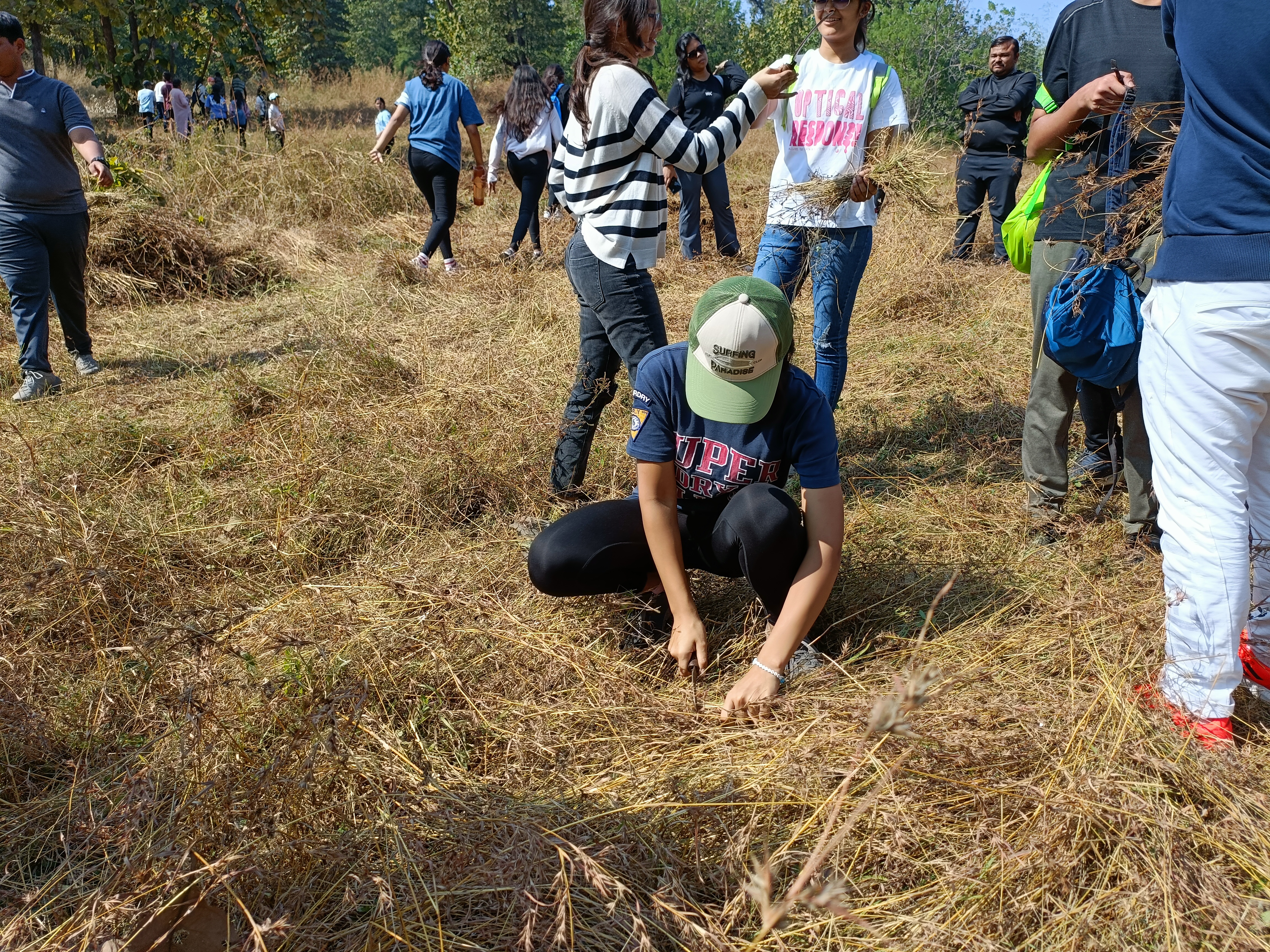
With 6 days of walking, stargazing, trekking, learning, and doing, we came back more ‘aware’, more ‘cultured’, and somehow even more humbled. For our ‘Rural Immersion’ programme we went to Mokhamal, Dang which is situated in the South of Gujarat. The aim was to return home more ‘aware’, more ‘experienced’, and having done more.
“My grandfather used to say that once in your life you need a doctor, a lawyer, a policeman, and a preacher. But every day, three times a day, you need a farmer.†– Brenda Schoepp
The most important part of the trip was seeing how it all happened. Our urban lives often grant us the privilege of not knowing where the food we eat comes from, or even having to worry about having enough food for all three meals of the day. But seeing how not everyone has the same privilege as me was revolting, it was jarring, and more than that it felt unreal. It is unreal how people lived in these places with such hard times and yet were always smiling. It is a hard life and seeing them live through it every day, still grateful for all that they have, was a lot to process. It made me think of the countless times I hadn’t been grateful despite all that I have.
LO1 – Identify own strengths and develop areas for growthÂ
Throughout the six days, I’ve learned so much about myself that I don’t think I would’ve otherwise. I’ve learned about agriculture, basic human survival in the wild, and using naturally found resources to make more. The experience showed me how much I could empathize with the people living there, and their livelihoods. It showed me just how much compassion I had. However, the experience showed me just how much I struggle with patience. For activities like harvesting the crops and then tying them all together, or the traditional churning of pulses to make flour. They required patience in plentiful and a lot of times I struggled with that.
LO2 – Demonstrate that challenges have been undertaken, developing new skills.
A lot of the skills I developed there were subjective to the experience. We wove baskets out of straw, painted warli art, and harvested crops. These skills are important for survival and not handy in our urban lives, which is what made the experience more memorable because this skill set was so subjective to the experience.
LO4 – Show perseverance and commitment in CAS experience.
The trip could have been a smooth sail had it been a day or max three days long, but it wasn’t. Having to show up to complete the drenching tasks again and again, almost like a routine. Yes, the exhaustion catches up to you by the third day, and you want to go back home, you’ve had enough “exposureâ€. But the thing about having to wake up on the fourth day despite it is that’s when you start committing to the experience. This was also why the last days felt so much easier because i had worked on and built my perseverance.Â
LO5 – Demonstrate skills and benefits of working collaboratively.
We often hear teamwork makes the dream work, but now we’ve seen the full extent of it. It’s impossible to do so many things at such a big scale, alone. Working with a team makes it easier, more doable, and so much more fun. Having my friends there to help contribute to tasks like big painting, teaching children, donating, or even farming, requires effort. I have also learned that when we do work together it helps us achieve more, and be there for each other along the way. Thus, teaching me the importance of working collaboratively.Â
LO6 – Engagement with issues of global significance
When you live so closely with a lifestyle very different from yours you can’t help but wonder how much luck was at play. Poverty is a real problem, especially in India but the fact we haven’t had many close interactions with it because we live in Urban areas is concerning. Just because you don’t see it everyday, can’t mean it doesn’t exist. The problem is this global issue needs to be talked about more, and ways to help people step out of it need to be discussed more. People need to know the importance of the problem at play. This was why when we were there i felt so obliged to pay my part and donate when we went to buy groceries and school supplies for the children at government schools.
The trip in taught me the importance of many things, the most important being “Just because life is easier on you, it’s not on everybody else.†The trip stands as a testimony for me and my friends to making better choices and helping more people out. It also stands as a reminder that we are too capable of showing compassion, so we must choose it every day. And that it doesn’t matter how much you have unless you know how to make the most of it all. Below are the photos from the trip:


