BAL MELA
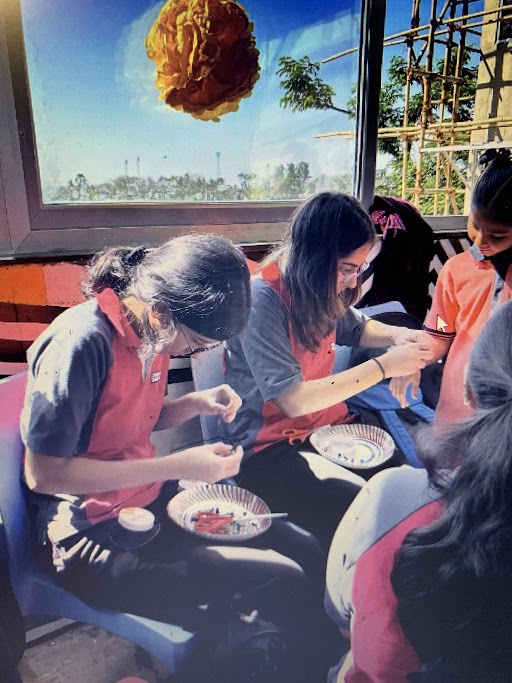
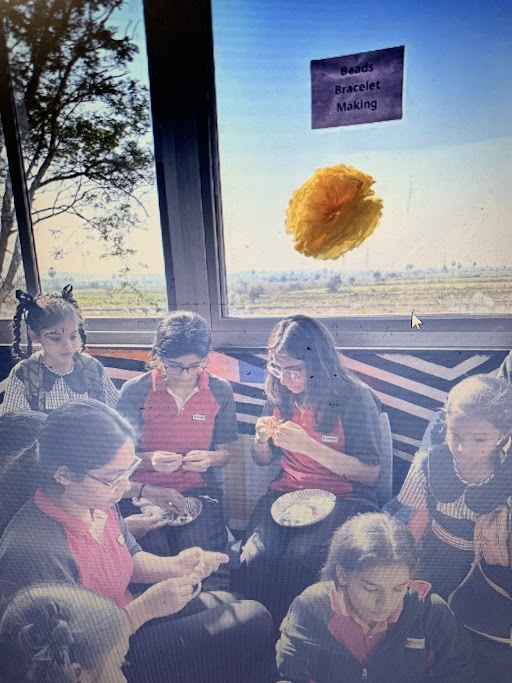
Yearly fountainhead school hosts an event called “bal melaâ€. This event’s only goal is to give kids impoverished fun-filled experiences.A lot of fun and imaginative activities were planned for the kids from government schools, including face painting, three-legged races, dog and the bone, and much more. In order to make a positive impact on society, we were provided with the opportunity to engage with the kids. As there were multiple activities to choose from I chose to be a part of the bracelet making stall for the kids. Our only goal was to provide pretty bracelets as per the kids’ wishes in a short span of time.
LO5 – Demonstrate skills and benefits of working collaboratively
Participating in this event enhanced my collaborative skills. Typically, I find collaboration easy when I know the my partners,, allowing me to confidently showcase my abilities and contribute to the overall success of our group. I strongly believe that working collectively leads to mutual improvement by addressing each other’s weaknesses and drawing inspiration from one another to enhance individual performance.During the Bal Mela event, collaborating with my close friends made the process much less of a struggle. However, we encountered challenges such as a friend struggling with knot tying, resulting in some bracelets breaking and increasing our workload. Despite the bustling stall, collaboration proved essential in managing the workload effectively. Each team member brought unique strengths to the table; for instance, I excelled in creative designs while others were really good at knot tying. This division of tasks enabled us to work more efficiently and cater to the needs of numerous children.
LO2 – Demonstrate that challenges have been undertaken, developing new skills.
Facing the challenge of tying knots with the plastic strands of the bracelets proved to be a difficult task for our team. Additionally, the huge demand at our stall, with a constant number of children requesting bracelets, added pressure on us. Because of the weak and fragile plastic material some bracelets broke , further intensifying our work. To overcome these challenges, we adopted a strategy. We divided tasks among team members, where each of us would create the bracelet only leaving the part of tying a knot to a helper that volunteered to join us. .By effectively managing our responsibilities we overcame these challenges, ultimately developing new skills in teamwork and task delegation.
LO3 – Demonstrate How to Initiate and Plan a CAS Experience
For Bal Mela, I began by organizing the materials we needed for the bracelet-making stall. I discussed with my team what designs and materials would be most suitable for the event, keeping in mind the children’s preferences and the time constraints. We made sure to have an assortment of beads, strings, and clasps readily available.Â
The planning was more difficult than initiating. While initiating the stall setup and starting the bracelet-making process was straightforward, the planning required anticipating challenges, such as the volume of children and the fragility of the materials. We had to ensure we had enough supplies and be prepared for the inevitable mistakes, such as broken bracelets. Planning and initiating activities are essential because they ensure that events run smoothly. Good planning allows you to be prepared for challenges, while initiation ensures that your plans are executed effectively. These skills are invaluable, not only for CAS experiences but for personal and professional life as well.
 LO7 – Recognize and Consider the Ethics of Choices and Actions
One ethical issue we encountered was ensuring that every child received equal attention and that all were treated fairly. As the stall got crowded, there was a risk of overlooking some children or rushing through their bracelet requests. We had to be mindful to maintain fairness and patience, ensuring that no child felt left out or neglected.Â
At times, it was overwhelming, especially when the stall became crowded. However, the ethical responsibility of treating every child equally made me more aware of the importance of fairness. It taught me to remain calm and considerate, even when under pressure.
Working collaboratively was a skill I extensively developed while participating in this event. For me, working collaboratively is generally easy if I know the people I am working with. I am able to demonstrate my skills with confidence that lead to the overall improvement of our group work. Moreover, I believe that working together brings out improvements in each other’s weaknesses as we learn from others and are motivated to work better for ourselves. For bal mela, working collaboratively was very easy for me because all the people i worked with were my close friends. One of my friends had a difficulty in tying the knot after putting the beads in which did lead to some bracelets breaking, this doubled our work. Our stall was very crowded and to manage making bracelets for so many kids wasn’t an easy task. Thus, working collaboratively helped bring down the work per person down. And each one had their own strengths. For example, I could come up with creative designs while the other could easily tie knots and thus we could work more effectively.
The highlight of this experience was the excitement of the kids when they received their finished bracelets. They very happily put them on and thanked us for the pretty ones. Furthermore, I learnt a new skill of making bracelets which is always a plus.